Kurt Friehauf - Teaching
Even if I knew that
tomorrow the world would go to pieces,
I would still plant my apple tree.
- Martin Luther
Contents
Courses I teach
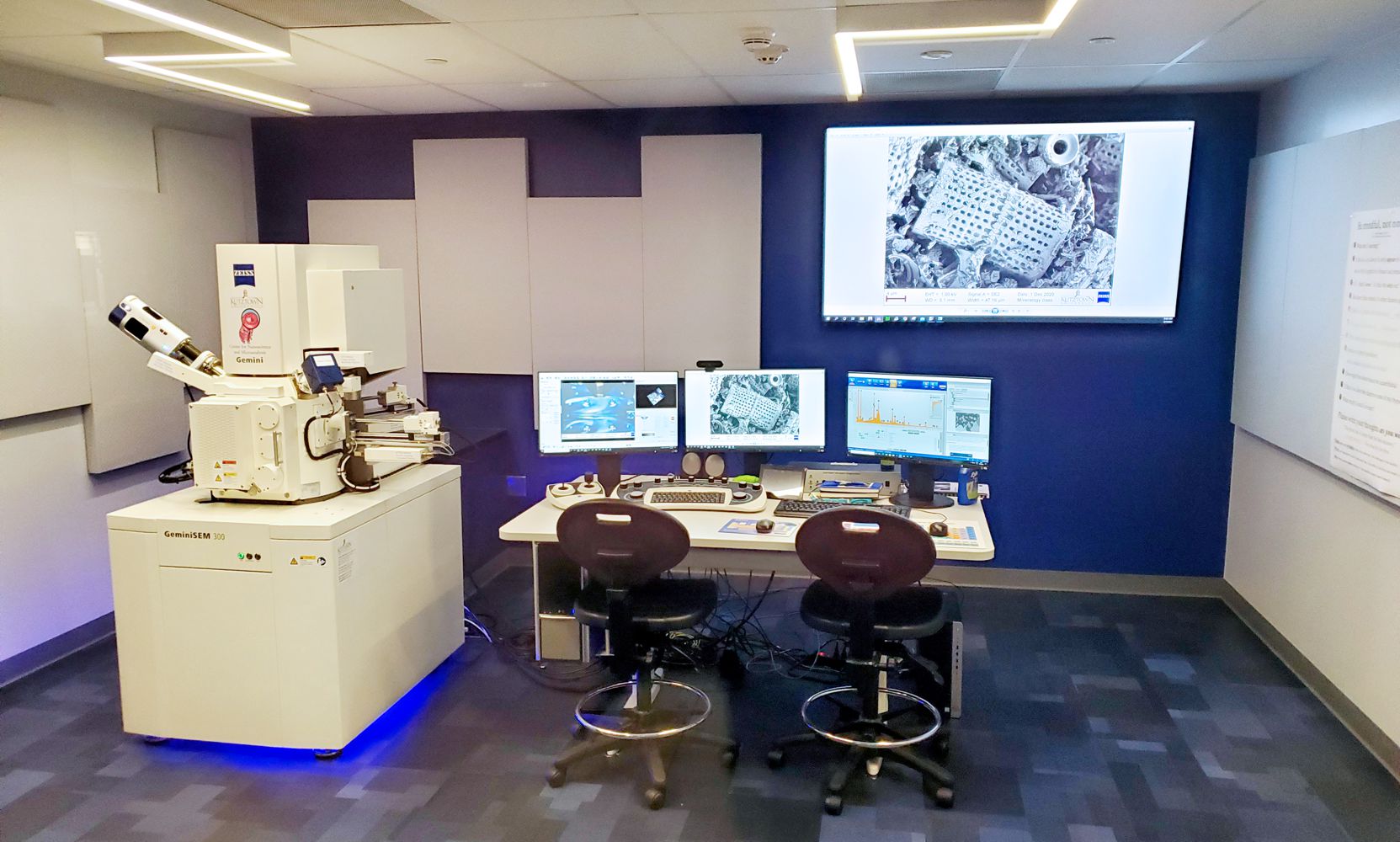
Practical Scanning Electron Microscopy + Lab
How to use a field
emission scanning electron microscope with energy dispersive
spectrometer
(photo: Fred and Martha Hafer Scanning Electron
Microscope Lab at Kutztown University)
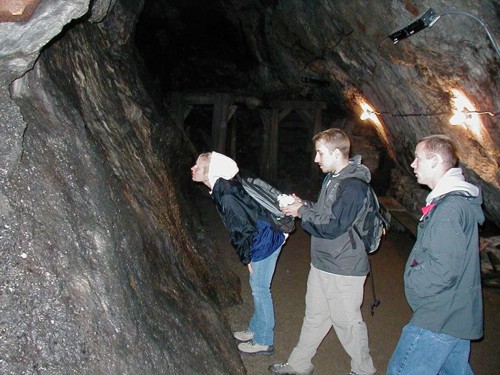
Mineralogy + Lab
How to identify
minerals and the chemistry of how minerals form
(photo: Sterling Hill zinc
mine)
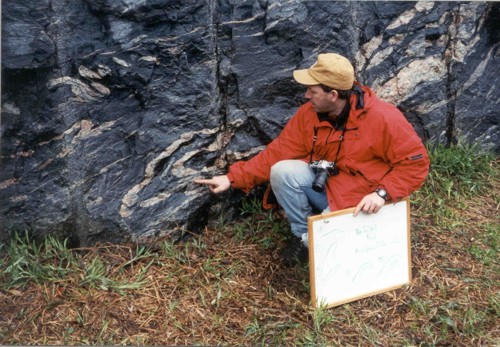
Petrology and Geochemistry + Lab
(formerly Igneous and
Metamorphic Petrology)
Studying the chemical
processes that form, modify, and destroy rocks, including how
magmas form/crystallize, how pressure/temperature recrystallize
rocks, and how water chemically reacts with rocks.
(photo: Adirondack Mnts.)
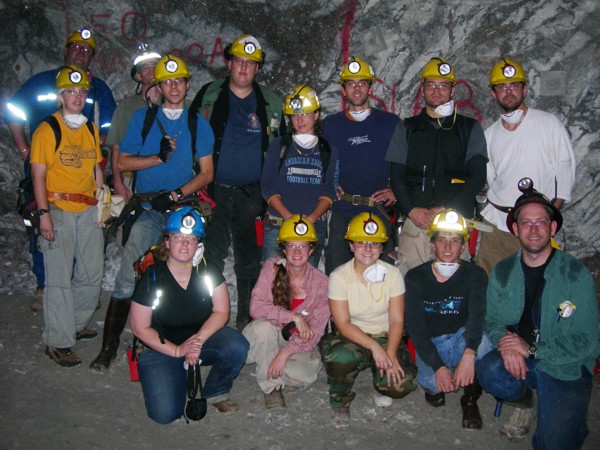
Economic Geology + Lab
How mineral deposits that we mine form
within the Earth and how we explore for them
(photo: underground in the Balmat zinc mine)
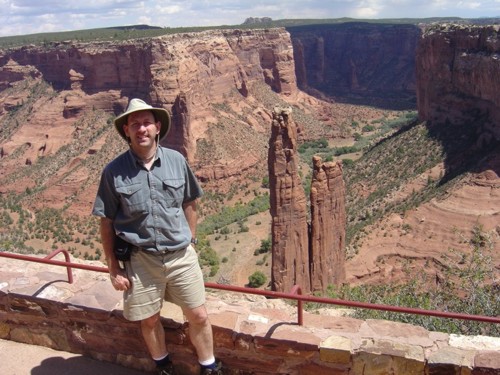
Geology of National Parks
The stories of the rocks
that you walk on when you go on vacation
(photo: Canyon de Chelly, AZ)
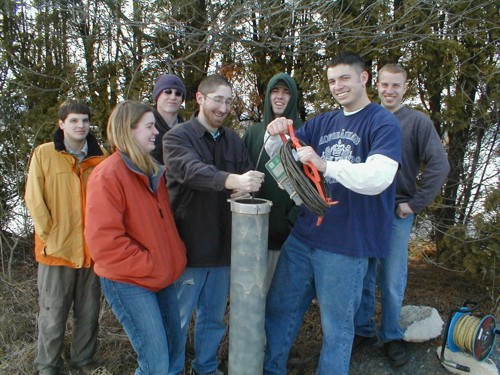
Senior Seminar in Geology
Synthesis of all of the
geology courses in the program through discussions of papers
published in the professional scientific journals, also includes
group research project
(photo: measuring pH, etc. in well)
Courses
I taught in the past
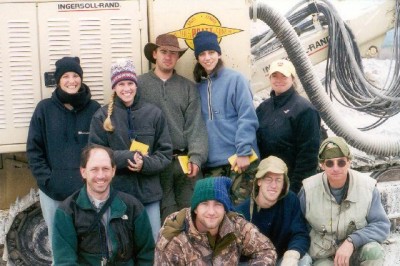
Optical Mineralogy + Lab
Using microscopes to study
mineralogy and applying a little mineral chemistry to deduce
geological processes
(photo: Nyco wollastonite mine)
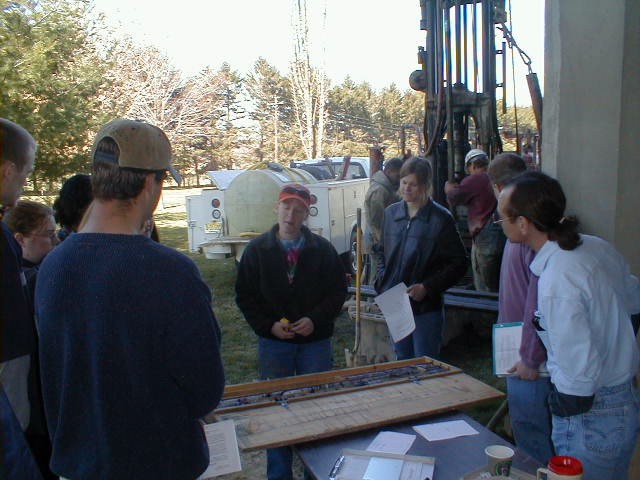
Structural Geology + Lab
Studying how stress deforms rock to form
folds and faults, how that applies to engineering, and
plate tectonic theory
(photo: measuring RQD in drill core at drill rig testing
rock strength)
(taught by
Dr. Sarah
Tindall as of
2003)
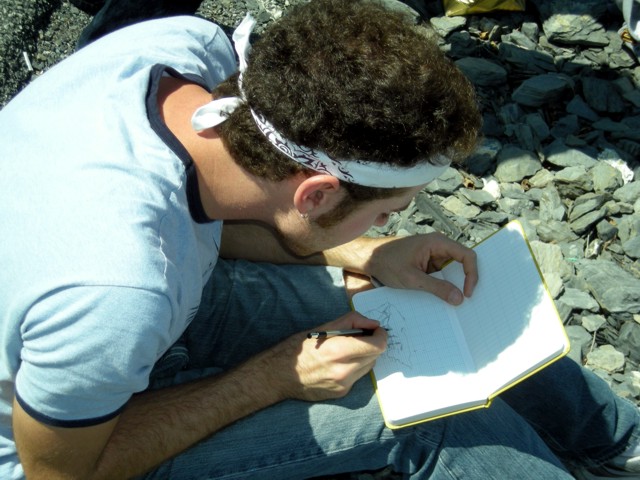
Field Geology
Standard field procedures
for geologists, including geologic mapping, rock/soil/water
sampling, geophysical methods, etc.
(photo: sketching outcrops
with
the art education students)
( now taught by Dr. Sarah Tindall )
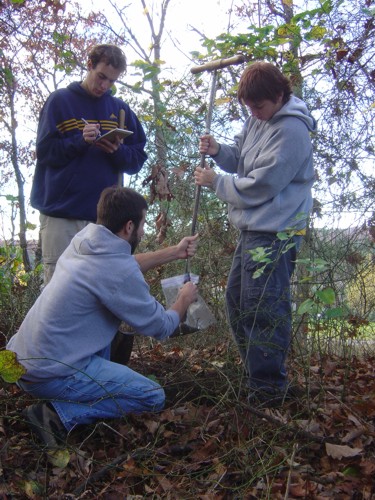
Environmental Geology + Lab
Geology related to
environmental science with an emphasis on practical experience
in the field
(photo: soil sampling near Palmerton, PA)
(taught by Dr.
Jacob Sewall as of 2009)
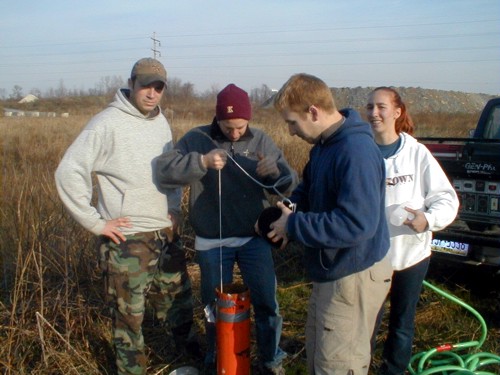
Hydrogeology + Lab
Geology related to
environmental science with an emphasis on practical experience
in the field
(photo: bailing from monitoring well)
(taught by Dr.
Laura Sherrod as of 2010)
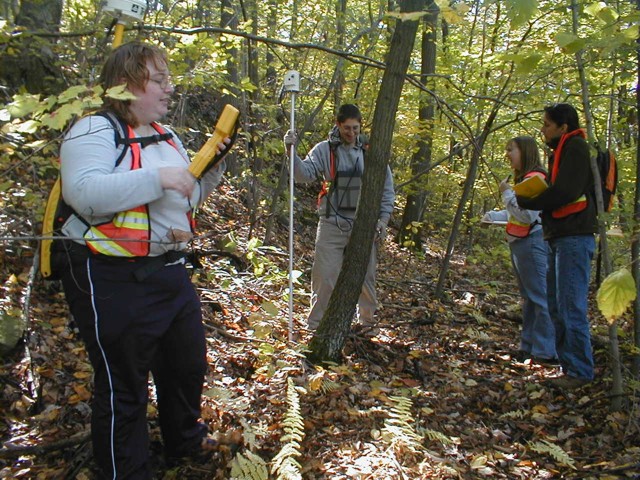
Geophysics + Lab
How we analyze the earth's
magnetism, gravity, electrical properties, and seismic
properties to find hidden things like water, oil, and minerals,
as well as understand processes otherwise invisible to us
(photo: measuring magnetic
field in Pennsylvania iron mining district)
(taught by Dr.
Laura Sherrod as of 2010)
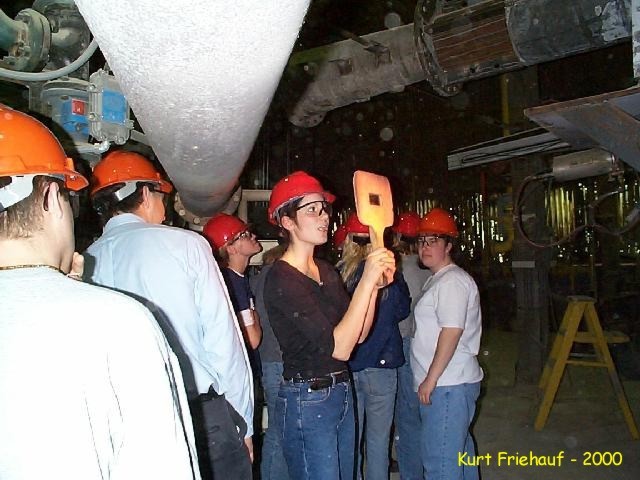
Physical Geology + Lab
Survey of the geological sciences for science
majors.
(photo:
viewing kiln at cement plant)
(taught
by Dr. Laura
Sherrod as of 2009)
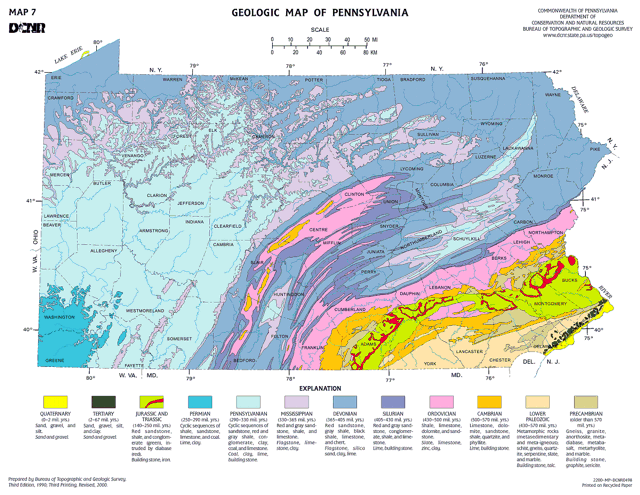
Intro to Geology + Lab
Survey of the geological
sciences for science and non-science majors, respectively
(taught by Dr.
Sarah Tindall as of
2009)
Travels with students - the
world is bigger than Kutztown, Pennsylvania!
Longer trips
Adirondacks -
Autumn 2022, 2021, 2019, 2018, 2017, 2016, 2015, 2013, 2012, 2011,
2010,
2009,
2007,
2006,
2005,
2004,
2002,
2000
Washington (state) - May 2016
Puerto Rico - May 2015
Adirondacks - Autumn 2014
Arizona - Summer 2014
Namibia
- Summer 2011
Alaska
- Summer 2011
Arizona
- March 2010 (Grand Canyon, volcanoes, meteorite impact site,
Petrified Forest, and copper mines)
Colorado/New
Mexico - August 2009 (Great Sand Dunes and Anasazi
sites)
Yellowstone
and southern Montana mines - May 2009
China
- Summer 2008 (Beijing + Henan)
Costa Rica - Winter 2007-2008 (volcano and beach tour)
China
- Summer 2005 (Beijing)
China
- Summer 2004 (Beijing and Inner Mongolia)
GSA meetings
Denver,
Colorado - October 2022
Phoenix, Arizona - October 2019
Seattle, Washington - October 2017
Vancouver, BC - October 2014
Denver, Colorado - November 2013
Denver,
Colorado - November 2010
Portland,
Oregon - October 2009
Harrisburg,
Pennsylvania - March 2006
Salt
Lake City, Utah - October 2005
Washington,
D.C. - March 2004
Seattle,
Washington - November 2003
Halifax,
Nova Scotia, Canada - March 2003
Denver,
Colorado - November 2001
Reno,
Nevada - November 2000
Undergraduate Research - an
important part of education
I am a strong advocate of using undergraduate
research projects to help students pull together the
knowledge they learn in their many classes. Earning a degree
in geology requires students to take a whole bunch of very
different science courses, ranging from classes on how volcanoes
erupt, to how beaches erode, to how earthquake vibrations travel
through the earth, to fossil identification, and much, much
more. Unfortunately, in spite of every professor's attempts
to tie what students learn in each class to the subject at hand,
the links between these subjects commonly just shows up as a line
or two in a notebook. DOING research
requires a person to pull this knowledge together to solve a
problem really helps build a strong fabric of knowledge gained in
all of those science classes.
Because research pursues the answers to questions with no pat
answer, research projects also teach students that there is not
always a single, obvious, correct answer to a given problem, and
research successes help build each student's self
confidence. Students doing independent research with me work
on projects including:
- Geological fieldwork on the origin of
Qinling Mountains molybdenum deposits, Henan,
China
- Geologic fieldwork at the Baiyunebo
(Bayan Obo) rare-earth-element deposit, Inner
Mongolia, China
- Origins of one of the oldest,
best-preserved porphyry copper-molybdenum deposits in the
world - Karas
region, Namibia
(summer 2011)
- Potential porphyry/epithermal
mineralization on Mount Fairplay - Interior
Alaska (summer 2011)
- Hydrogeology and rock properties of
karst aquifers near limestone quarries near Kutztown,
Pennsylvania
- Development of home-made geophysical
electrical resistivity instrument
- Electron microprobe study of
the occurrence of gold in the Ertsberg porphyry copper deposit, West
Papua, Indonesia
- Economic geology of Proterozoic
iron deposits in the Pennsylvania, New Jersey, and New York (mid-Atlantic iron belt)
- Petrology of igneous and metamorphic
rocks from variety of locations
A
nice four-year plan for any undergraduate student
(by the Career Services Staff at Kutztown University of
Pennsylvania)
My advice for students who are not doing well in
college