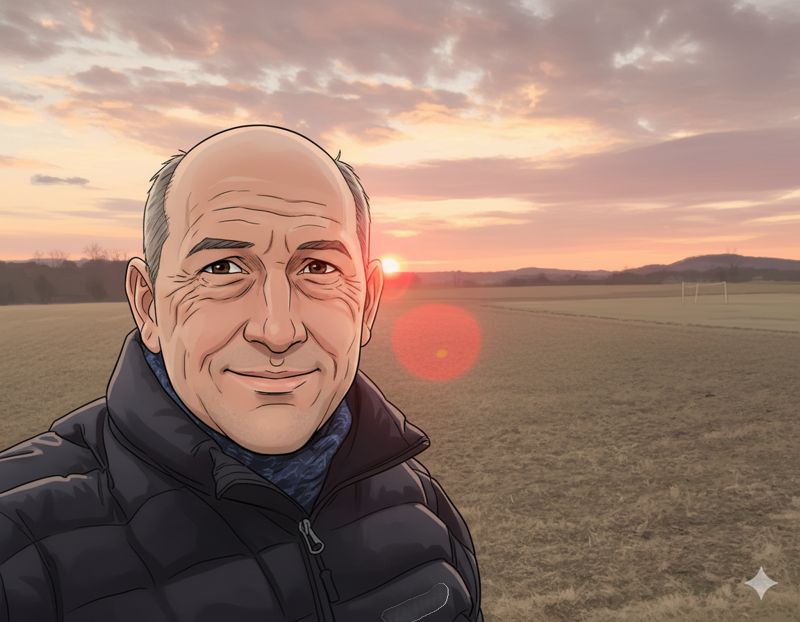
Kurt
Friehauf
Associate Professor of Geology
Dept. of Physical Sciences
Boehm Science Building Room 135
Kutztown University of Pennsylvania
Kutztown, PA 19530
Tel: 610-683-4446
FAX: 610-683-1352

We are all partners
in a quest.
The essential
questions have no answers.
Questions unite people.
Answers divide them.
Elie
Wiesel
- 1986 Nobel Peace Prize
|
Courses I teach and
philosophy of the importance of undergraduate research in education
|
Applying science to answer
questions whose answers are not in the
textbooks... yet!
|
Science outreach,
geology club, and various committees I'm on that help students
|

Daily
schedule
When and where to find me |

Curriculum
Vitae
(resume) |
Why
would anyone want to become
a
geologist? Travel pictures, favorite quotes, books, hobbies,
recommended links, etc.
|
Courses
taught

Mineralogy
How to identify minerals and the chemistry of how
minerals form
(photo:
Sterling Hill zinc mine)
|

Optical Mineralogy
Using microscopes to study mineralogy and
applying a little mineral chemistry to deduce geological processes
(photo: Nyco
wollastonite mine)
|

Igneous/Metamorphic Petrology
Studying the origins of rocks that form by
cooling of hot magmas/lavas (igneous rocks) and rocks that form by
recrystallization and chemical reaction at high temperature and
pressure (metamorphic rocks)
(photo:
Adirondack Mnts.)
|

Geology of National Parks
The stories of the rocks that you walk on when
you go on vacation
(photo: Canyon
de Chelly, AZ)
|

Environmental Geology
Geology related to environmental science with an
emphasis on practical experience in the field
(photo: soil sampling
near Palmerton, PA)
|

Hydrogeology
Geology related to environmental science with an
emphasis on practical experience in the field
(photo: bailing from
monitoring well)
|

Senior Seminar in Geology
Synthesis of all of the geology courses in the
program through discussions of papers published in the professional
scientific journals, also includes group research project
(photo: measuring pH,
etc. in well)
|

Physical Geology and
Intro to Geology
Survey of the geological sciences for science and
non-science majors, respectively
(photo: viewing kiln
at cement plant)
|

Structural Geology
Studying how stress deforms rock to form folds
and faults, how that applies to engineering, and plate tectonic theory
(photo: measuring RQD
in drill core at drill rig
testing rock strength)
(now taught by Dr.
Sarah Tindall) |
Travels with students
±Week long trips
China - Summer
2008 (Beijing + Qinghai)
GSA
meetings
Harrisburg, PA - March 2006
Salt Lake City, UT - October 2005
Washington, D.C. -
March 2004
Seattle, WA - November 2003
Halifax, Nova Scotia, Canada
- March 2003
Denver, CO - November 2001
Reno, NV - November 2000
Friehauf's
Book of the Semester Club
Each semester, I choose a
geology-based book that I recommend to my students. Although I
do not require my
students to read these books,
there are valuable
extra credit points available to students who can demonstrate they
read,
remember, and understand the material. (note:
links are to original publishers, but you can find a better deal if you
shop around)
Undergraduate Research - an important
part of education
I
am a strong advocate of using undergraduate
research projects to help
students
pull together the knowledge they learn in their many classes.
Earning
a degree in geology requires students to take a whole bunch of very
different
science courses, ranging from classes on how volcanoes erupt, to how
beaches
erode, to how earthquake vibrations travel through the earth, to fossil
identification, and much, much more. Unfortunately, in spite of
every
professor's attempts to tie what students learn in each class to the
subject
at hand, the links between these subjects commonly just shows up as a
line
or two in a notebook. DOING
research
requires a person to pull
this
knowledge together to solve a problem really helps build a strong
fabric
of knowledge gained in all of those science classes.
Because
research pursues the answers to
questions with no pat answer, research projects also teach students
that
there is not always a single, obvious, correct answer to a given
problem,
and research successes help build each student's self confidence.
Students doing independent research with me work on projects including:
- Geological
fieldwork on the origin of nickel deposits, Qinghai, China
(Summer 2008)
- Geologic
fieldwork at the Baiyunebo (Bayan Obo)
rare-earth-element
deposit, Inner Mongolia, China (Summer 2004)
- Hydrogeology
and rock properties of karst aquifers near limestone
quarries near Kutztown, Pennsylvania
- Development of
home-made geophysical electrical resistivity instrument
- Electron
microprobe study of the
occurrence
of gold in the Ertsberg porphyry copper deposit, West Papua,
Indonesia
- Economic
geology of Proterozoic iron deposits in the Pennsylvania, New Jersey,
and New York
- Petrology of igneous and metamorphic
rocks from
variety of locations
A
nice four-year plan for any undergraduate student (by the
Career
Services Staff at Kutztown University of Pennsylvania)
Research
projects
My
research integrates extensive field mapping data and petrographic work
with thermodynamic modeling to evaluate metasomatic chemical reaction
paths.
My current research projects focus on:
- origins of the giant rare
earth element deposit at Bayan Obo
(Inner Mongolia, China),
- evolution
of the Ertsberg diorite-hosted
porphyry mineralization (West Papua, Indonesia),
- geological factors affecting groundwater
flow and cave
formation
near a
local limestone quarry, and
- origins
of the belt of magnetite
deposits in eastern
Pennsylvania and New
Jersey.
At Bayan
Obo,
we are looking
at chemical variations in the limestone rocks that host the
orebodies
to see if there is evidence for influence by carbonatite magmas (either
as orthomagmatic lava flows and intrusions, or due to hydrothermal
activity related to carbonatite intrusions at depth). This work
is in collaboration with Dr. Xiao Rongge at the China University of
Geosciences in Beijing. I brought three Kutztown University
undergraduate students to China with me
in the summer of 2004 to aid in
this work.
At Ertsberg,
my field
mapping (1999-2002)
revealed the system to be hosted by several igneous phases that
alternate
in time with multiple structural and hydrothermal events. I am
currently
refining that work through petrographic studies aimed at constraining
the
fluid chemistry, temperature, and pressure.
In collaboration with
Dr.
Spencer Titley and Stacie Gibbins (University of Arizona), I am
also studying the
origins
of the giant Grasberg porphyry copper deposit in the same
district.
Although the Grasberg and Ertsberg
porphyry deposits occur within 2 km
of one another and apparently formed within 100,000 years of one
another
in relation to similar igneous rocks, metasomatism around the Grasberg
center is much more intense and widespread. The ultimate goal of
this project is to draw a comparison of physiochemical conditions
between
these two contrasting systems to identify some of the factors that
affect how porphyry hydrothermal systems evolve.
I
am also investigating, along with a crew of Kutztown University
undergraduate
researchers
The groundwater
flow and cave formation research is
in
collaboration with Dr. Lane Schultz of the Berks Products
Corporation and Dr.
Sarah Tindall. We are
comparing hydrologic data such as changes in groundwater table
and groundwater chemistry (temperature, pH, etc.) in a field of
monitoring wells with rock types and fracture patterns mapped in the
adjacent quarry. Our goal is to determine the relative importance
of different types of fractures, the abundance of fractures, and the
chemistry of the limestone rocks in affecting cave formation and
groundwater flow in the area.
The
focus of the magnetite
(iron) deposits of the eastern U.S.
research is to
determine if the
Proterozoic
magnetite deposits scattered throughout eastern Pennsylvania,
northern
New Jersey, and southern New York are related to one another and, if
they are, learn what causes the subtle variations in their
geology. These old magnetite deposits may be similar in
origin to the much younger iron deposits that occur in contact aureoles
of plutons
intruding
the Triassic/Jurassic rift basins nearby, which Rose et al. (1985)
proposed to be the result of hydrothermal
activity
related to
regional
fluid flow of non-magmatic (basinal? evaporative?) brines. The
widespread scale of the
many small magnetite Proterozoic deposits, their relationship to
hydrothermally altered wall rocks, and the spatially systematic
variation in this alteration and the host rock types suggests the
Proterozoic deposits are related to the same general geologic event and
that different deposits formed at different depths. This work is
in collaboration with Dr. Robert C. Smith II (Pennsylvania Geological
Survey) and Richard Volkert (New Jersey Geological Survey).
My Ph.D. research combined field
mapping
with detailed petrographic studies, investigations of the carbon-oxygen
isotope systematics in carbonate rocks, and irreversible thermodynamic
reaction path modeling to document metasomatic reactions in carbonate
rocks
by fluids given off during the late stages of the crystallization of
felsic
magmas (i.e. porphyry copper deposits). These aqueous solutions are
analogous
to those recorded in active geothermal systems in volcanic arcs of the
circumpacific (e.g. Pinatubo Philippines and White Island New
Zealand).
The exposures in the mine at Superior Arizona provided remarkable
access
to the hydrothermal system there, allowing detailed study of 1) the
geology
of carbonate-hosted massive sulfide replacement ores, 2) factors
affecting
the relative sulfur, metal, and chlorine budgets metaliferous solutions
upon reaction with wall rocks, and 3) the evaluation of stable isotopic
tracers in determining fluid flow paths in carbonate rocks.
Most
recent publications (names in italics indicate
student co-authors)
- Friehauf,
Kurt C., 2007, Iron-sulfur redox and its effect on
sulfur isotope fractionation in carbonate-hosted Cu-Au replacement
ores, Superior, Arizona [abs]: Arizona Geological Society Ores and
Orogenesis - Circum-Pacific Tectonics, Geologic Evolution, and Ore
Deposits, Tucson, AZ, September 24-30, 2007.
- Smoyer, Justin, Kuhn, Michelle,
Friehauf, Kurt, and Quinn, Paul V. Sr., 2006, Design for a manually
controlled multiple electrode electrical resistivity array for student
geophysical surveys [abs]: Geological Society of America Northeastern
Section
– 41st Annual Meeting (20–22 March 2006), Harrisburg, PA, Program with
Abstracts, v. 38, no. 2, p. 89.
- Mathur,
Ryan, Ruiz, Joaquin,
Titley,
Spencer
R., Gibbins, Stacie L., and Friehauf, Kurt C., 2005, A detailed
Re-Os
isotope
study of ores and sediments from Ertsberg District: Evidence
linking
porphyry copper mineralization to periphery skarn mineralization and
the
importance of the surrounding continental crust as a source for
metals: Ore
Geology Reviews, v. 26, no. 3-4, p. 207-226.
- Friehauf,
Kurt,
Gibbins, Stacie, and Titley,
Spencer, 2005, Porphyry-Style Mineralization in the Ertsberg
Diorite,
Gunung Bijih (Ertsberg/Grasberg) District, West Papua, Indonesia: in Porter, T.M., ed.,
Super Porphyry Copper & Gold Deposits - A Global
Perspective, PGC Publishing, Adelaide, Australia, v. 2, p. 357-366.
- Friehauf,
Kurt C., Dilliard,
Kelly, and Pope, Michael C., 2005, A Geochronology Puzzle –
Integrating
Relative and Absolute Age Studies in Introductory Courses [abs.]:
Geological Society of America Annual Meeting (October 16-19, 2005) Salt
Lake City, UT, Program with Abstracts, vol. 37, no. 7, p. 152.
- Artz, Zachary J., Friehauf, Kurt
C., and Xiao, Rongge, 2005, Comparison of Banded Ores in the
Main/East,
West, and South Orebodies of the Giant Bayan Obo REE District, Inner
Mongolia, China [abs.]: Geological Society of America Annual Meeting
(October 16-19, 2005) Salt Lake City, UT, Program with Abstracts, vol.
37, no. 7, p. 500.
- Gibbins,
Stacie L., Titley,
Spencer, and Friehauf, Kurt, 2005, Porphyry Cu-Au Mineralization in
the
Ertsberg Intrusion, West Papua, Indonesia: Style, Timing, and Sources
of Hydrothermal Fluids [abs.]: Geological Society of America Annual
Meeting (October 16-19, 2005) Salt Lake City, UT, Program with
Abstracts, vol. 37, no. 7, p. 314.
- Wolfinger,
Seth, Ward, Kristen, Holland, Jeremy, Nase, Andrew, Ferguson, Lisa,
Zellner, Greg, Friehauf, Kurt, Tindall, Sarah, and Schultz, Lane
2004,
A Multidisciplinary Study of Controls on Ground-Water Flow in a Karst
Aquifer in the Ordovician Beekmantown Group, Berks County, PA [abs.]:
Geological Society of America Northeastern
Section (39th Annual) and Southeastern Section (53rd Annual) Joint
Meeting
(March 25-27, 2004) Geological Society of America Abstracts with
Programs, vol.
36, no. 2, p. 128.
Service
activities
A committee is a cul-de-sac down which
ideas are lured and then quietly strangled.
- Sir Barnett Cocks
Why
would anyone want to become a geologist?
Geology is
largely for science-loving people
who like travel, nature, and working with diverse people. I've
really
enjoyed
my career as a
geologist because it gets me out of the office and puts
me in strange new environments with little mysteries to solve.
Geological problems require me to really look carefully at things,
bring together my knowledge of many other fields of science, and
analyze the data in a logical and creative way. Creativity is an essential facet of science that many people
overlook! Personally, I'm particularly attracted to the
practical aspects of applied geology
that has direct value to people, but geologists also do fascinating
research on fundamental processes.
In addition to scientific adventure,
my geologic studies allow me to work with a
wide variety of people from different cultures, many of
whom
I would never have otherwise encountered, and seen places relatively
few folks
back
home have seen. I believe that a lot of the conflict between
people in the
world is due to a lack of understanding of each other's
viewpoints. Ignorance allows us to think of strangers as
something less than as human as ourselves and so causes us to become
callous, uncaring, disdainful, and even hateful. Traveling and
meeting people in person helps destroy that ignorance, enables us to
see people as more than simple stereotypes or abstract, symbolic icons
on a map, and so paves the way for new friendships and opportunities
for productive cooperation. I have yet to
visit a place inhabited solely by monsters - most people are pretty
cool, although there are certainly a few jerks everywhere you go.
I hope that the following section begins to
illustrate
that point.

Travels (click on
country of interest) (well,...sorry, it'll work once I map the
image)
Additional websites I've created for
general education of people surfing the web
Personal
stuff
Favorite
quotes:
- Vincent Van Gogh
- Love
many things, for therein lies the true strength, and whosoever loves
much performs much, and can accomplish much, and what is done in love
is done well.
- Thomas Berger
- The
buffalo eats grass, I eat him, and when I die, the earth eats me and
sprouts more grass. Therefore nothing is ever lost, and each thing is
everything forever, though all things move. ("Little Big Man")
- Michel
de
Montaigne
- Nothing
is so firmly believed as what we least know.
- Not
being able to govern events, I govern myself.
- How
many things we held yesterday as articles of faith which today we tell
as fables.
- Horace
Mann
- Do not
think of knocking out another person's brains because he differs in
opinion from you. It would be as rational to knock yourself on the head
because you differ from yourself ten years ago.
- Henri-Frédéric
Amiel
- All
appears to change when we change.
- Benjamin Franklin
- It
is the first responsibility of every citizen to question
authority.
- They
who
would give
up an essential liberty for temporary security, deserve neither liberty
or security. (Letter
to Josiah Quincy, Sept. 11,
1773)
- Thomas Jefferson
- Dissent
is the highest form of patriotism.
- I find
that the harder I work, the more luck I seem to have.
- Voltaire
- Think
for yourselves and let others enjoy the privilege to do so too.
- I
disapprove of what you say, but I will defend to the death your right
to say it.
- Our wretched species is so made that those
who walk on the well-trodden path always throw stones at those who are
showing a new road.
- Will and Ariel Durant
- History
is subject to geology. Every day the sea encroaches somewhere
upon the land, or the land upon the sea; cities disappear
under the water, and sunken cathedrals ring their melancholy
bells. Mountains rise and fall in the rhythm of emergence and
erosion; rivers swell and flood, or dry up, or change their
course; valleys become deserts, and isthmuses become
straits. To the geologic eye all the surface of the earth is a
fluid form, and man moves upon it as insecurely as Peter walking on the
waves to Christ. (The Lessons of History, Chapter 2)
- A
great civilization is not conquered from without until it has destroyed
itself from within.
- Harry S. Truman
- A
pessimist is one who makes difficulties of his opportunities and an
optimist is one who makes opportunities of his difficulties.
- It is
amazing what you can accomplish if you do not care who gets the credit.
- Aristotle
- Without
friends no one would choose to live, though he had all other goods.
- Will Rogers
- Everybody
is ignorant, only on different subjects.
- Never
let yesterday use up too much of today.
- If
advertisers spent the same amount of money on improving their products
as they do on advertising, then they wouldn't have to advertise
them.
[I believe that this principle applies to
time and complaining, as well.]
- Mahatma Gandhi
- You must be the change you wish to see in the world.
- I shall pass through this world but once. Any good therefore
that I can do or any kindness that I can show to any human being, let
me do it now. Let me not defer or neglect it, for I shall not pass this
way again.
- Mother Theresa
- We
ourselves feel that what we are doing is just a drop in the ocean. But
the ocean would be less because of that missing drop.
- Greek Proverb
- A
civilization flourishes when people plant trees under whose shade they
will never sit.
- Raymond E. Feist
- Never
accept the proposition that just because a solution satisfies a
problem, that it must be the only solution.
- Latin American proverb
- Mal
de mucho consuelo de tontos.
Recommended
authors and books:
- Geology
Fiction
- Jack
DuBrul (author of the Philip
Mercer action
series - a geologist with all the talents of James Bond and MacGyver
who saves the world on an annual
basis - these books are a lot of fun - they're like action movies in
paperback
form!)
- Susan
Cummins
Miller (writes
the
Frankie
MacFarlane mystery series - another geologist who solves murder
mysteries
- Miller really has the feel for field geology)
- Sarah
Andrews (writes the Emily
"Em" Hansen
mystery series - a geologist who solves murder mysteries)
- Fiction
- Nonfiction
- Poetry
Recommended links:
- Magazines
- Radio programs
- Radio
Lab - very interesting program that
investigates fundamental things (New York Public Radio) - they do
science in a very accessible format
- This American Life - interesting
interviews, essays, and stories about regular (and irregular!) American
people - the essence of our country (Chicago Public Radio) (weekly)
- Le Show - Harry
Shearer's very funny satire news program (he's an actor, director, and
the voice of 21 characters on The Simpsons) - (weekly)
- The World - world news - makes up
for coverage greatly lacking in the mainstream media (also has fun
geography quizzes)
- Democracy Now! - an
independent news source that helps balance the view from mainstream
media
- Hearing Voices - "the largest
collective of independent radio producers this side of the semi-planet
Pluto"
- Radio Times with
Marty Moss-Coane - excellent interviews with people in the news
- Justice Talking - program
focusing on your legal rights (weekly)
- On the Media - news about where
we get our news (weekly)
- Living On Earth - environmental news (weekly)
- Sound and Spirit -
program that explores how we express spirituality with music (weekly)
- Humankind -
"voices of hope and humanity" (weekly)
- Talk of the Nation Science Friday
- weekly program interviewing people on science topics in the news
- Essays